
Every manuscript submitted to the Indonesian Actuarial Journal is assessed on its scholarly merit alone. The journal follows the COPE Ethical Guidelines for Peer Reviewers.
Type of review
The journal operates a single-blind review process: the identity of the authors is known to the reviewers, but the identity of the reviewers is not disclosed to the authors.
Workflow at a glance
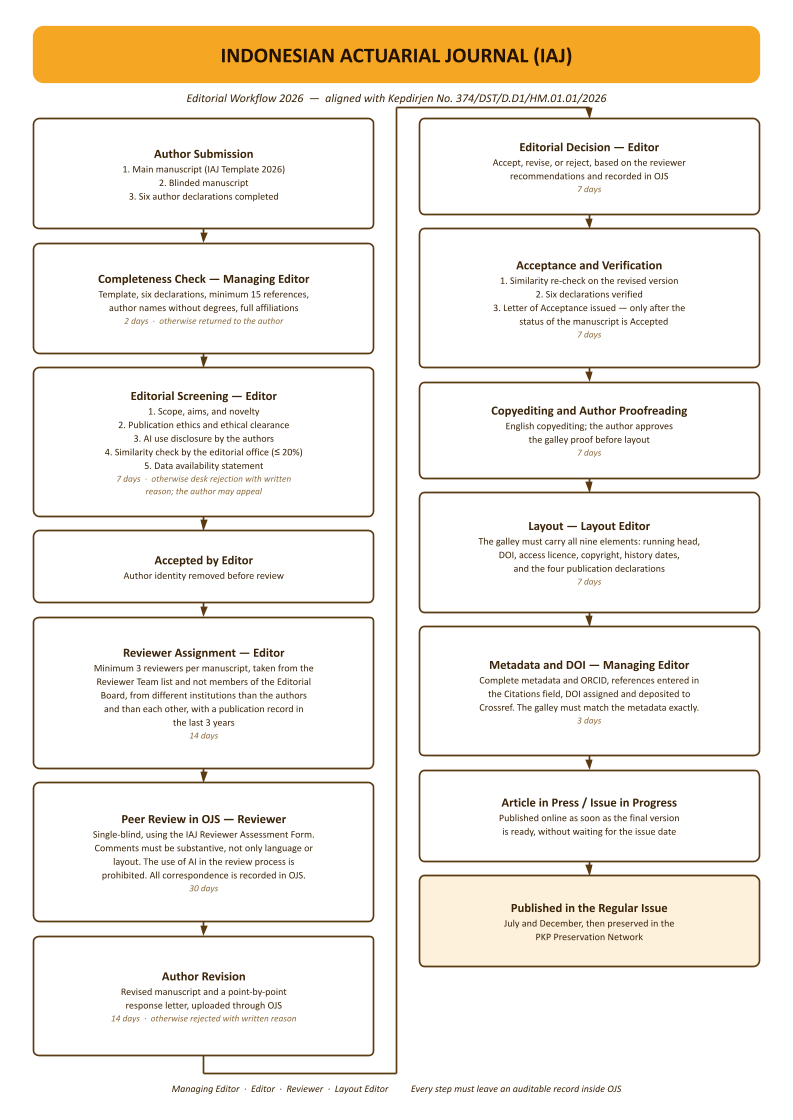
Stages of the process
- Completeness check. The Managing Editor verifies that the submission uses the official template, that all author declarations are completed, that the reference list meets the journal's requirements, and that author names and affiliations are correctly presented. Incomplete submissions are returned to the author within two working days.
- Editorial screening. An Editor assesses the fit with the aims and scope of the journal, the novelty of the work, the standard of written English, the ethical clearance statement, the data availability statement, and the disclosure of any use of artificial intelligence. The editorial office also runs a similarity check at this stage. Manuscripts that do not pass screening are rejected within seven days, with written reasons.
- Reviewer assignment. The Editor assigns at least three reviewers per manuscript, selected from the journal's Reviewer Team according to their field of expertise. Reviewers are drawn from institutions other than those of the authors, and members of the Editorial Team do not serve as reviewers. Reviewers have seven days to accept or decline an invitation.
- Review. Reviewers have thirty days to complete their assessment using the IAJ Reviewer Assessment Form inside the journal's Open Journal Systems platform. Reviewers are asked for substantive comments on the content and depth of the work.
- Author revision. Authors are given fourteen days to submit a revised manuscript together with a point-by-point response letter. A revision is not a guarantee of acceptance.
- Editorial decision. The Editor decides to accept, request further revision, or reject, based on the reviewers' recommendations. The decision and its reasons are recorded in the journal platform.
- Acceptance and verification. The similarity check is repeated on the revised version and all author declarations are verified. A Letter of Acceptance is issued only after the manuscript has formally reached the status of accepted.
- Production and publication. The accepted manuscript is copyedited and returned to the author for proofreading, laid out in the journal template, and assigned a Digital Object Identifier. It is then published online as an Article in Press before being included in the regular issue.
Criteria for assessment
Reviewers assess the title, the abstract, the keywords, the originality of the work and its analysis of the research gap, the depth of the analysis and synthesis, the conclusions, the proportion and recency of the references, and the fit with the scope of the journal. The full expectations are set out in the Instructions for Reviewers.
Similarity checking
The editorial office checks every manuscript with similarity detection software at screening and again on the revised version. A similarity score above twenty per cent, excluding references and properly cited quotations, is returned to the author for paraphrasing.
Use of artificial intelligence
Reviewers are prohibited from using artificial intelligence in the review process, including uploading a manuscript into an artificial intelligence application and using such tools to analyse, assess, or draft review comments. The journal's full position is set out in the Artificial Intelligence Policy.
Expected duration
From submission to publication the process takes approximately four months where one round of revision is required. The journal does not offer a fast track and does not guarantee acceptance under any circumstances.
Appeals
An author who believes a decision rests on a factual misunderstanding may appeal in writing to editorial.iaj@aktuaris.or.id within thirty days, setting out the grounds. Appeals are considered by the Editor in Chief, whose decision is final.